As of 2026-05-27 UTC, Baidu's Apollo Go is useful to read as something more concrete than a robotaxi headline. It is one of AI-China's clearest examples of an embodied agent loop: the model observes a city scene, plans within a bounded operating domain, acts through a vehicle, reports back into fleet operations, and is judged by rides completed rather than prompts answered. Baidu's first-quarter 2026 results put the scale marker in plain terms: 3.2 million fully driverless operational rides in Q1, a weekly peak of more than 350,000 rides in March, more than 22 million cumulative public rides as of April, and a global footprint of 27 cities as of May 2026.[1]
That does not make Apollo Go a simple proof that autonomous driving is solved. It makes it a better use case for judging what "agentic AI" means when the action surface is expensive, regulated, and physical. A browser agent can retry a failed form submission. A robotaxi has to deal with roads, passengers, municipal rules, vehicle cleaning, weather, maps, teleoperations, edge compute, app matching, and the reputational cost of blocking traffic. The technical point is that the AI-China agent race is no longer confined to chat, office documents, code workspaces, and short-video creation. In Baidu's case, it is also visible as an urban service with wheels.
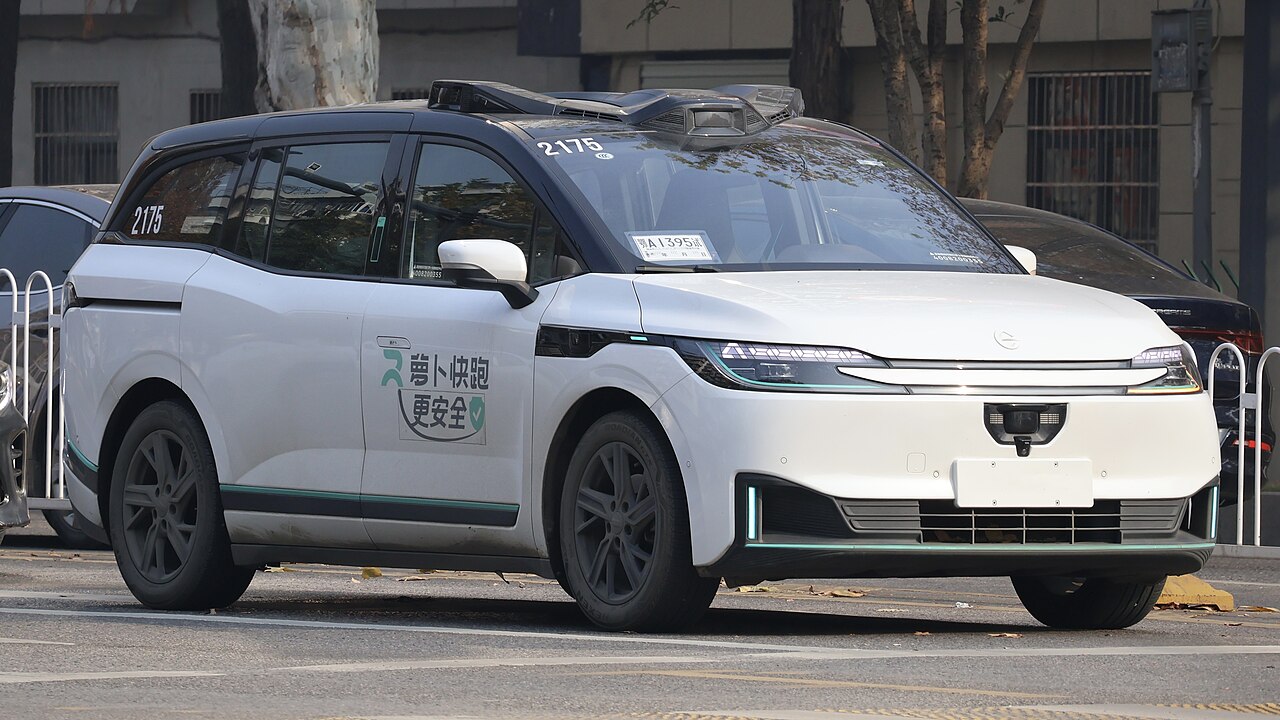
Image context: the cover uses a real Wikimedia Commons photograph of an Apollo Go Apollo RT6 on Heping Avenue in Wuhan, taken on December 17, 2025. It is deliberately a street photograph rather than a diagram, dashboard, or synthetic rendering because the article's claim is about operational AI in public space.[6]
The use case is bounded autonomy, not general magic
The clean way to understand Apollo Go is to separate the autonomy claim from the deployment claim. Baidu's Apollo ADFM announcement in May 2024 described an autonomous-driving foundation model supporting L4 applications, with multimodal perception, multi-source planning, and a staged path toward end-to-end autonomous driving.[2] That is the model-layer story. It says Baidu wants the driving stack to generalize across more of the urban scene than a brittle rule system could manage.
The deployment story is narrower and more important. L4 driving does not mean a car can drive everywhere under every condition. It means the system can perform the full driving task inside a defined operational design domain. Apollo Go's progress should therefore be read city by city, zone by zone, and permit by permit. Baidu's 2022 announcement of commercial fully driverless permits in Wuhan and Chongqing framed that transition carefully: the service could collect fares without a human driver in the car, but within designated areas and daytime operating windows, after staged testing with safety operators first in the driver seat, then in the passenger seat, and then no operator inside the vehicle.[3]
That boundary is not a weakness in the thesis. It is the thesis. The useful AI product is not a car that declares itself generally intelligent. It is a system that can take a bounded patch of city, a regulated service area, a defined fleet, an app-based demand channel, and enough safety evidence to turn autonomous driving into a repeatable transport product.
Why Wuhan matters
Wuhan is not just a backdrop for Apollo Go. It is the proving ground where vehicle economics, public acceptance, and city operations meet. The Apollo ADFM launch happened in Wuhan in May 2024, and Baidu's permit history already tied Wuhan to the first commercial fully driverless ride-hailing authorization in China in 2022.[2][3] By late 2025, the RT6 was visible enough on Wuhan streets to appear as ordinary traffic photography rather than only corporate launch imagery.[6]
That matters because a robotaxi service has to cross a threshold that many AI demos avoid: it must become boring enough to be infrastructure. The model's output is not a polished paragraph. It is a route completed, a pickup found, a lane negotiated, a passenger dropped off, and a fleet state updated. Each successful ride teaches less than a laboratory benchmark would like, but the accumulation of rides exposes the system to the kind of mundane edge cases that decide whether autonomy is a service or a stage demo.
Baidu's Q1 2026 figures show the service moving from novelty toward operations scale, but they also show why the bar is hard. More than 330 million autonomous kilometers and more than 220 million fully driverless autonomous kilometers are fleet-scale claims, not model-card claims.[1] They imply an operating machine behind the vehicle: safety monitoring, map updates, depot work, charging, remote assistance, weather policy, incident handling, and local regulatory interfaces. My inference is that Apollo Go's real moat, if it develops one, will sit in that operating machine as much as in the driving model itself.
The model is only one layer of the agent
Apollo ADFM gives Baidu a foundation-model vocabulary for autonomous driving, but the robotaxi "agent" is a stack. At the bottom are sensors, vehicle control, localization, maps, and embedded compute. In the middle are perception and planning. Above that sit fleet dispatch, routing policy, ride-hailing integration, customer support, charging, cleaning, maintenance, and exception handling. At the top are the city-level constraints: where the service is allowed to drive, when it may charge fares, how it shares road space, and what reporting regulators require.
This is why Apollo Go belongs in the AI-China conversation even though it is not an LLM release. It makes the word "agent" materially harder. The system has to act in the world, but the action is not one model call. It is a coordinated chain of model inference, vehicle actuation, fleet supervision, and business-process routing. A passenger does not care whether the stack used a foundation model, a rules module, or a remote-assistance fallback. The passenger cares whether the car arrives, drives safely, handles the pickup point, and resolves problems without turning the ride into a support ticket.
Baidu's public metrics therefore need two readings. The bullish reading is that ride volume, city count, and fully driverless kilometers suggest a real operations curve.[1] The cautious reading is that those metrics do not reveal unit economics, disengagement rates, remote-assistance load, adverse-weather availability, depot utilization, or service quality by city. Those are the details that decide whether a robotaxi fleet becomes a scalable AI business or an impressive but expensive operations project.
Overseas partnerships turn the fleet into a platform test
Apollo Go's international push adds a second test: can a Chinese autonomous-driving stack travel through non-Chinese platforms and regulators? In July 2025, Baidu and Uber announced a multi-year partnership to deploy thousands of Apollo Go autonomous vehicles on the Uber platform across markets outside the United States and mainland China, with initial deployments expected in Asia and the Middle East.[4] By early 2026, Baidu and Uber were positioning Dubai as one of the next operating surfaces; a later Baidu announcement said Apollo Go had begun fully driverless commercial ride-hailing in Dubai with Dubai Taxi Company and described Apollo Go Park in Dubai as an overseas operations and management hub supporting plans for a fleet of more than 1,000 autonomous vehicles in coming years.[5]
That sequence is strategically important. In China, Apollo Go can lean on Baidu's own app surface, local city relationships, and domestic autonomous-driving history. Overseas, the stack has to plug into other demand channels, other transport authorities, and other customer expectations. Uber gives Baidu demand aggregation and rider UX reach, but it also makes Apollo Go more legible as a supplier inside a larger mobility marketplace.[4] Dubai tests a different interface: government smart-mobility goals, taxi-company operations, and an overseas hub that has to turn vehicles into a managed service rather than a shipped product.[5]
The implication is that Apollo Go is becoming a two-sided AI-China export test. One side is technology: whether the model and vehicle stack can adapt to new roads and rules. The other side is operations: whether Baidu can reproduce the support, fleet, and regulator loop outside its home market.
What would prove or break the thesis
The strongest confirmation would be boring growth: more fully driverless rides, wider operating hours, fewer brittle zone edges, clearer service quality, lower intervention burden, and city launches that move faster because the stack is reusable. Baidu's May 2026 claim of a 27-city footprint gives the article a concrete baseline; the next question is whether those cities deepen into high-availability services or remain uneven pilot surfaces.[1]
The second confirmation would be visible integration with platform partners. If Uber riders in qualifying markets can reliably choose or be matched with Apollo Go vehicles, and if that experience survives ordinary pickup complexity, the Chinese robotaxi stack becomes part of global ride-hailing supply rather than a standalone national showcase.[4][5]
The falsifier is straightforward. If ride growth depends on subsidies, restricted showcase zones, unusually favorable weather, heavy remote support, or opaque safety reporting, then Apollo Go remains a managed demonstration at scale rather than a durable transport product. The same is true if overseas deployments stay stuck in announcements while domestic operations produce impressive totals without transparent service quality.
For now, Apollo Go is worth tracking because it changes the shape of AI-China analysis. It moves the question from "which model is strongest?" to "which model-backed system can operate a service in the world?" In a robotaxi, the agent is not just the neural network. It is the vehicle, fleet, app, city permit, operations center, and exception-handling loop working together. That is a harder benchmark than a leaderboard, and a more useful one.[1][2][3]
Sources
- Baidu, "Baidu Announces First Quarter 2026 Results" (Apollo Go Q1 2026 ride volume, March weekly peak, cumulative public rides, city footprint, and autonomous-kilometer claims).
- Baidu Apollo, "百度Apollo重磅发布了全球首个支持L4级自动驾驶的大模型Apollo ADFM" (May 15, 2024 Apollo ADFM announcement and model-layer description).
- Baidu, "Baidu Granted China's First-Ever Permits for Commercial Fully Driverless Ride-Hailing Services" (August 2022 Wuhan and Chongqing commercial fully driverless permit announcement).
- Baidu and Uber, "Baidu and Uber Join Forces to Accelerate Autonomous Vehicle Deployment" (July 2025 multi-year partnership for Apollo Go vehicles on Uber outside the U.S. and mainland China).
- Baidu, "Baidu's Apollo Go Commences Fully Driverless Commercial Ride-Hailing in Dubai, Partners with Dubai Taxi Company" (2026 Dubai commercial launch and overseas operations hub context).
- Wikimedia Commons, "File:(CHN-Hubei) Apollo Go Apollo RT6 Temporary-鄂A1395试 2025-12-17.jpg" by S5A-0043 (source page for the real December 2025 Wuhan RT6 photograph used as the article image).